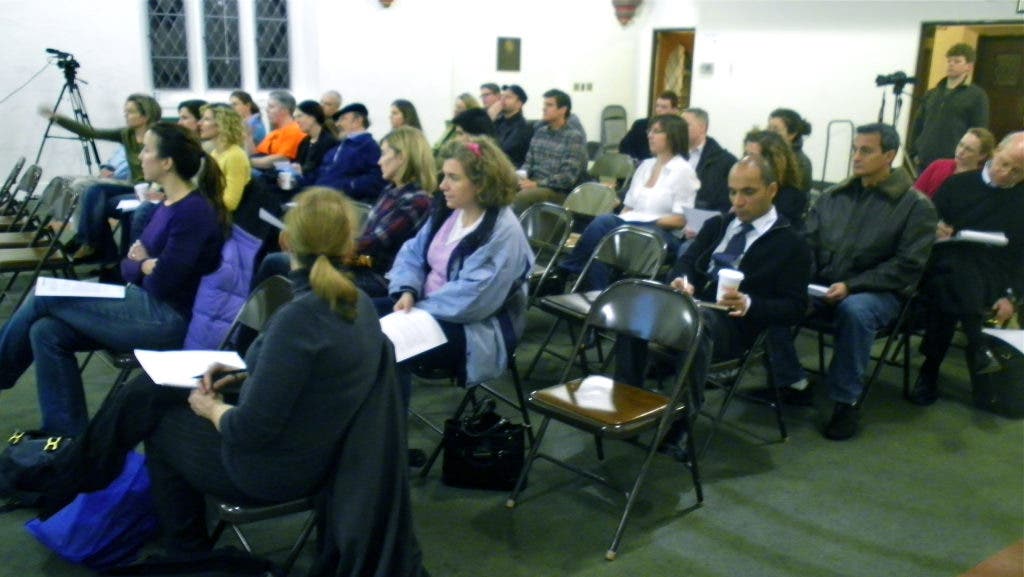
As one would expect from a conference featuring three noted, mathematicians, there were no easy answers given during Tuesday’s Community Math Night in Pelham.
The forum, which took place inside the , was hosted by the Pelham Math Committee and attended by more then three dozen community members. The Pelham Math Committee is an organization dedicated to removing the Pelham school district’s controversial elementary school math curriculum, “Investigation in Numbers, Data and Space.”
Alan Siegel, a computer science professor at the New York University joined Stanley Ocken and Ethan Akin, both professors at City College of New York, gave their observations on the math curriculum and during the forum.
Jennifer Slattery, one of the members of the Pelham Math Committee, said the professors weren’t simply chosen because of their documented opposition to the Investigations. Slattery said the professors also have insight into the type of skills the district’s students will need in order to successfully take math courses at the college level and obtain math level careers.
“A math level career isn’t just being a mathematician or being physicist, it’s also science, engineering, medicine and finance,” Slattery said.
The district’s elementary school math curriculum, “Investigations in Number, Data and Space," has come under fire from a number of parents who believe and doesn’t place enough emphasis on a traditional, systematic algorithm-based learning and homework.
The concerns have been shared by parents and educators across the nation.
Last month, the Pelham school board agreed to to review the district’s math curriculum at a cost not to exceed $18,000. Their work is scheduled to begin this month.
Akin, who has studied concepts for teaching K-12 math during the past decade, said that Investigations didn’t do an adequate job of drilling the basics of math into students at an early enough age. This becomes problematic as those students move into more advanced levels of math, because processes that should come naturally to students are cumbersome and difficult.
Ocken said one major flaw with Investigations and similar curriculum is that it deals with special cases at the expense of general procedures. Although it’s important to be able t illustrate initial computations to students at times, Oken said Investigations fails to transition students from pictorial representations to abstract math concepts by the time they are in high school.
“Six divided by three has lots of real life interpretations,” Oken said. “Three divided by eight has fewer real life computations and when a student gets to high school and encounters the expression x divided by y, it’s extremely important to understand that expression has zero real life computations.”
Siegel recalled one student he had who was bright, but had learned math through Investigations.
“On the mid-term, he was 20 points below the next lowest performing student in my class and he was the only student to fail my course,” Siegel said. “He was smart enough to get into NYU, but with his background he was not going to be able to specialize in economics, computer science, business... I am here in part because I regret not being able to get him up to speed and students like him.”
During the session, one woman asked the panel if supplementing her child’s lessons with Singapore math, another curriculum, would be enough to make up for the deficiencies of Investigations.
Ocken said he didn’t believe that supplementation is effective.
“Skills have to be taught in a carefully sequenced way and part of the art of educating children is how to understand the sequence, the procedures that they are learning—the importance of difficulty,” Siegel said.
Claire Allen, a district parent, said the forum was informative.
“It made me realize that it is important process for us to evaluate other math programs outside of Investigations,” Allen said.
The Pelham Math Committee is expected to have a video stream of the forum up on their Web site this week.
It often appeases parents (when I first got concerned, I went into school officials and district leaders to get consistent back-filling, aka supplementing, for students... and then it became clear that wasn't the answer because it doesn't solve the problem so it doesn't fill the gaps). But as Dr. Ocken was explaining it --- and when the video is available, it'll be said more articulately by him -- supplementing with real math in class doesn't work because the concepts and habits of mind of Investigations mean the child is never actually learning the math. I see this at home with my son who used to look at a number sentence and NOT guess, but work it out in his mind, or have it in his memory b/c of the practice he had in class in another district. Now, he guesses or estimates as a first effort.... If you remind him guessing isn't figuring out the right answer,he dutifully reminds you that this is how they do it in school... Everyone raises their hand or discusses it at their table and gets to guess and estimate. This might eventually lead to the right answer, but there's not much real learning there when the answer was right mostly because so-and-so happened to guess it. Watching it in practice is disturbing.
The article presents fundamental principles about learning as researched by cognitive psychologists. It expresses dismay over education papers that cite the Cognitive Psychology literature but misrepresent the conclusions as being the diametric opposite of the actual findings. The authors also repudiate programs that refrain from teaching systematic methods. They explain that beginners are not ready to extract general principles from explicit examples, and must therefore be taught the underlying principle directly. They refute many of the main features of constructivism. They're a pretty qualified group: Herb Simon won the Turing Award for making “basic contributions to artificial intelligence, the psychology of human cognition, and list processing.” The Turning award is the equivalent of the Nobel prize in computer science. Simon also won the Nobel Prize in Economics “for his pioneering research into the decision-making process within economic organizations;” the National Medal of Science; and the American Psychology Association’s Award for Outstanding Lifetime Contributions. The others hold various awards, too.
I think that the authors and the paper and myself both agree with their statement: “There is unanimous agreement that what is desired is not rote learning but learning with understanding. We need research that will tell us how to assess better than we do now when a student is performing by rote, and when and to what degree understanding has been achieved. For a long time there has been evidence (Katona, 1940) that knowledge and skill acquired with understanding is retained better and transferred better than that which is acquired by rote.” Perhaps the curriculum in your district is awful, I actually don't feel qualified to weigh in on how kids learn elementary math because I'm doing my PhD research in student thinking in Calculus(and yes, I teach Calculus at a University). I do know that my university students have very few meanings for mathematical ideas and have memorized rote procedures with no understanding. When choosing a new curriculum, make sure to ask for help from a math educator in picking something that doesn't promote rote learning. Don't just go "back to basics" and think that the kids will have any idea what they are doing when the find answers quickly and easily with algorithms.
If you take the stand that he meant "computations", he's wrong. There is but one computation (by this I mean final result, not method) for 6 divided by 3, namely two, for 3 divided by 8, namely 3/8ths or 0.375, and there is but one computed result for x divided by y, x/y. Okay, so maybe he meant 'interpretations' after all he's a mathematician, he must know his math. Six divided by 3: how many 3's are in 6, how much is in each of three groups when sharing 6 items, the relative magnitude of 6 with respect to 3; there's three. Three divided by eight: how many 8's are in 3, how much is in each of of eight groups when sharing 3 items, the relative magnitude of 3 with respect to 8; again three interpretations. Let's check x/y (let's ignore his blatantly encapsulated meanings for variables and adopt it ourselves): how many y's are in x, how much is in each of y groups when sharing x items, the relative size of x with respect to y; again, three interpretations. Hmm, Dr. Ocken claimed that there were many, less, and none...I came up with three for each. And yes, those interpretations overlap. If we actually provide meaning for the variables x and y, I can create infinitely many interpretations for x/y. Again, Dr. Ocken, the mathematician, is wrong. By the way, did I mention that I am a mathematician?
The comment linked to Neil's analysis of the statistical report and made the good point that PMC attributed findings to the statistical report that were not actually in the report. Neil and I also care a lot about the quality of math in your district-we are trying to push people to think critically about what is being said and who is qualified to be an expert. I'd take a look at another interpretation of the statistical report-one written by a statistician and a math educator. You know it must be good if they deleted it! http://mathlovergrowsup.teachforus.org/2012/01/29/pelham-math-committee-misrepresents-statistics-in-math-war-over-curriculum/ I'd look critically at how your elementary school teachers are trained, what they understand about math and how they are implementing the curriculum. You are seeing problems at home, and I'd guess that professional development might be a better use of your district's money than changing books. It is common for teachers to misunderstand what constructivism says about learning and implement ineffective strategies-maybe if everyone involved learns what this theory says the implementation of the curriculum will improve and people will be happier.
http://www.youtube.com/watch?v=1YLlX61o8fg Nowhere close to the depth of your academic experience, just concerns from a real father in the real world. I really hope you are right.